

Twelve months ago, a pricing project was a pricing project. Today, no serious pricing engagement starts without first putting the business model on the table.
The lever everyone wants to pull, pricing, no longer behaves the way it used to until it is clear what business the vendor is now in. Pricing remains the destination, and the answer customers eventually buy. But the path now runs through the business model, and the business model is changing.
In the last six months alone, we have redesigned the pricing of five vertical B2B software companies. In each one, the actual leverage came from clarifying the business-model question first, then solving pricing against it. What follows is the structured version of that argument: diagnosis first, then strategy, then pricing.
Part 1 · Diagnosis
The vertical software playbook is being rewritten
01The five classical moats erode simultaneously
For two decades, the successful vertical software playbook rested on a stable mix of five capabilities: domain expertise, UX, high engineering cost as an entry barrier, data lock-in and contractual lock-in. No single moat carried a winner, the strongest companies combined three or four into mutually reinforcing positions. Domain expertise drove the right product, the product earned the right contracts, the contracts secured the data, and the data fed back into deeper domain knowledge.
AI is now eroding all five at once, and one of them transforms.
- Codified domain expertise becomes replicable.
The parts of process knowledge that can be written down and modeled can now be assembled in weeks rather than years. The implicit, hard-won judgment of long-time practitioners decays more slowly, but the functional gap competitors need to close has shrunk dramatically.
- UX shifts from end-user surface to operator and exception layer.
When AI agents execute, the polished interface that justified premium pricing serves a shrinking population of human users. What remains is the approval, exception and oversight UI, a different design problem.
- The engineering cost barrier collapses.
Smaller teams ship what once took dozens.
- Contractual lock-in becomes harder to defend.
Customers demand portability and shorter terms as multi-vendor agent orchestration makes single-vendor dependence look outdated.
- The exception is data lock-in: it does not vanish, it inverts.
AI makes extraction and migration meaningfully easier, weakening the classical „your data is trapped here" effect. But the data itself becomes the fuel for the new value creation. The moat shifts from cost of leaving to value of staying: customers no longer want to escape the data, they want to extract more from it. Incumbents who recognize the pivot can turn a defensive moat into an offensive one.
The erosion is the typical case, not the universal one. Narrow, deep verticals with concentrated domain expertise; heavily customized software with idiosyncratic per-customer configuration; and heavily regulated software where compliance and certification carry real cost, in all three contexts, individual moats hold up longer than the headline argument suggests. The general direction is unchanged. The clock differs.
02Where value migrates: the two-axis map
Value now migrates along two structurally distinct axes. The vertical axis tracks how much value the system creates from accumulated data, from raw capture, through refinement and recommendations, to data-driven decisions. The horizontal axis tracks how much work the system performs autonomously, from manual operation through selective and human-in-the-loop automation to fully autonomous execution.
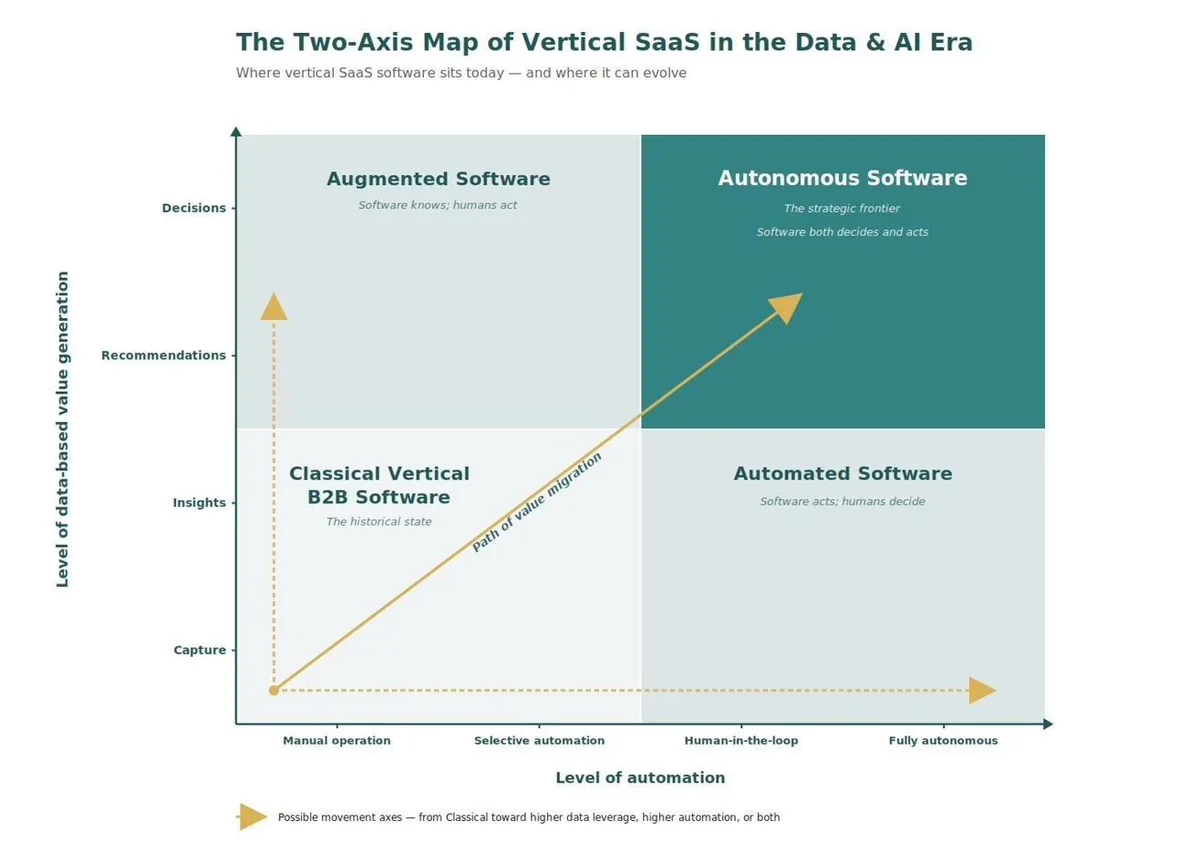
Combined, the axes yield four zones. Classical Vertical Software sits in the bottom-left: humans operate the tool, data is captured but rarely turned into value. Augmented Software adds data-driven intelligence with execution staying with the human; value comes from what the system knows. Automated Software executes work humans previously performed along defined rules; value comes from displaced labor. Autonomous Software combines both, the system decides and acts. That corner is where margins, defensibility and customer relevance ultimately concentrate.
The two axes do not require each other. Many vendors will move along both, but a meaningful share, especially in narrow, deep or heavily regulated verticals, will deliberately specialize on one or stay close to the origin.
03The bulk of future value lives on these axes
The bulk of future value will be created on these two axes, not on the data-capture-and-tooling layer that vertical software has historically occupied. Capturing data and providing software-as-a-tool are both becoming commodities. Refining data into intelligence and automating previously human work, that is where the value moves.
The contest for those upper layers is already underway. AI-native challengers build decision and agent layers from scratch. Hyperscalers and horizontal AI platforms move down into industry verticals. System integrators assemble custom solutions on top of customer data. And customers themselves are increasingly capable of building in-house AI on data they consider theirs.
A vendor that stays in the bottom-left does not stay in the same competitive position. It becomes the commoditized supplier of someone else's value chain.
Part 2 · Strategy
Three implications, four pathways, and one position to avoid
01Three structural implications
The value shift does not leave the business model intact. Three consequences follow directly, and they apply, in different intensities, to almost every vertical software company. These are not strategic choices. They are structural obligations.
- The business object shifts from software to data and execution.
Customers no longer pay primarily for access to a tool, they pay for the value extracted from the data layer underneath and the work that gets automated on top of it. That is a different kind of business, with different engineering investments (data infrastructure, AI workloads, agent operations), different competitive instincts (defending a data and automation position, not a feature roadmap), and different contractual structures (data ownership, audit, model and agent governance).
- Data sovereignty requires openness, paradoxically.
The classical moat was containment: keep the customer's data inside, make it expensive to leave, control the experience end to end. In the data and AI era, that instinct is corrosive. Value on the upper rungs comes from combining data, internal operations with external context, with third-party signals, with AI workloads drawing on multiple sources. Sovereignty in this era no longer means owning a closed silo; it means controlling the data layer of an open ecosystem. Open APIs, interoperability and third-party connectivity stop being concessions and become preconditions.
- The revenue logic becomes layered.
When a vendor sold a single product, it could price that product with a single logic, typically per seat, sometimes per module. In the new world, the same vendor operates across multiple value layers simultaneously: the human-facing tool, the data layer, the AI workloads, sometimes a platform on top. Pricing one logic across all of them either leaves money on the table or misaligns with what the customer is actually consuming.
02The four strategic pathways
The implications above apply to almost everyone. The pathways do not, they are choices. Three of the four adjust to the new value layer, actively repositioning along the data and automation axes. One contains, preserving the existing position instead.
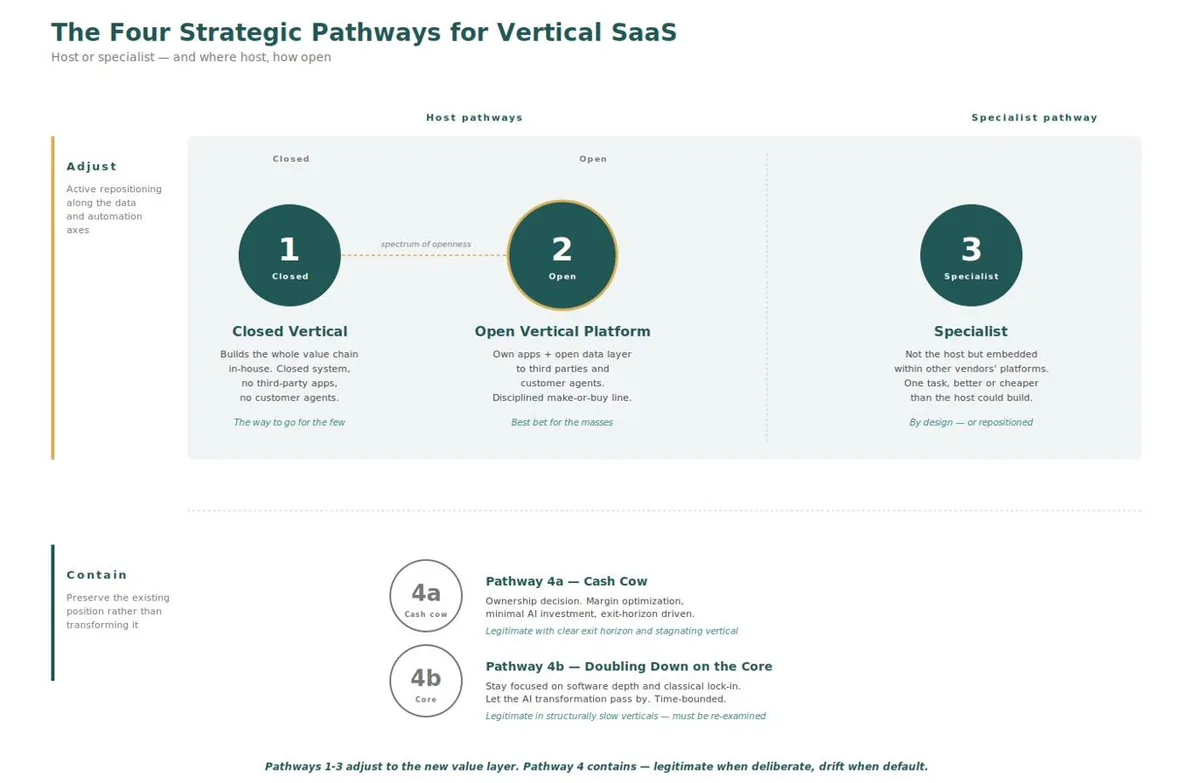
Pathway 1: Closed Vertical
The vendor builds the entire value creation itself, climbing on both axes within a closed system. No third-party developer program, no customer-built agents, all relevant use cases delivered inside the vendor's own product surface. The way to go for the few whose structural conditions support it: a narrow vertical with limited use-case heterogeneity, a market position strong enough to plausibly cover the full product surface, regulatory or structural protection, and the engineering capacity to build along both axes alone.
Pathway 2: Open Vertical Platform
The vendor opens the data layer to third parties and customer-built agents through APIs, a developer program and typically a marketplace, while at the same time building proprietary AI applications on the same data substrate. A deliberately drawn make-or-buy line decides which apps the vendor builds and which it leaves to partners. This is the default pathway for mid-sized to large vertical software companies, for a simple structural reason: no single vendor can build everything in real depth, but enough vendors have the market position to host a meaningful platform. Procore in construction and Veeva in life sciences are the cleanest current examples.
Pathway 3: Specialist
Not the host of a platform but a specialist embedded within other vendors' platforms, delivering one defined task better or more cheaply than anyone else, including the host's own potential build. Two variants that should not be confused: the Specialist by Design, most often AI-native, built from the start as a component to plug into existing host systems; and the Repositioned Specialist, a former vertical software company that has cut back from a broader product surface to its strongest single capability. The second variant is harder to execute because it requires letting go of a previous identity.
Pathway 4: Doubling Down
The vendor recognizes the shift but deliberately chooses not to follow it, or to follow it only at the margins. 4a Cash Cow: an ownership decision, typically PE-driven, that runs the business toward an exit horizon with margin optimization and minimal AI investment. Legitimate where the vertical is stagnating or in decline and the value-creation thesis is consolidation, not transformation. 4b Doubling Down on the Core: stays focused on software depth and classical lock-in, integration depth, regulatory adherence, embedded workflows, training, certification, and consciously lets the AI transformation pass by. Time-bounded, not a permanent state; the wait must be revisited at least every 12 to 18 months.
The make-or-buy line
Inside Pathway 2, the decisive operational discipline is the make-or-buy line. For each potential application the vendor decides: can we deliver this scalably, in real depth, with a structural advantage over specialists? Where yes, build. Where no, leave to third parties.
Vendors who lack this discipline gradually rebuild every attractive third-party application themselves, become competitors to their own ecosystem, and watch partners exit.
03The position to avoid: drift
Drift is the most expensive strategy in vertical software, and the only one that doesn't look like one.
Pathway 4 chosen by drift rather than by design is the most expensive non-decision in vertical software. From the outside, the drift case and the deliberate case can look identical for a while. The market eventually distinguishes between them, and the distinction is rarely flattering for the drift case.
A practical test separates Pathway 1 from Pathway 4b in disguise: what concrete investments on the data axis and the automation axis have actually happened in the last 18 months? A real Pathway 1 vendor can point to evidence, data infrastructure built, AI applications shipped, automation deployed. A vendor claiming Pathway 1 but unable to show it is more likely in Pathway 4b in Pathway 1 clothing.
For Pathway 4 to be strategy rather than drift, the structural conditions need to be honest. Pathway 4a needs a genuine exit horizon and a vertical that is stagnating, not just a year of soft growth read as decline. Pathway 4b needs a vertical where the value shift is structurally slower than average and a deliberate re-examination at least every 12 to 18 months. A 4b decision that is never revisited stops being a strategy and starts being inertia.
Part 3 · Pricing
Why sophisticated pricing can lose you your best accounts
01Per-seat is breaking. Subscription is not.
The distinction matters because it changes what is actually being adjusted. Subscription is a revenue model: recurring payment for ongoing access. Per-seat is one of several possible metrics for measuring what is being subscribed to, module, site, transaction tier and customer volume are all valid alternatives. Per-seat became the default because, in the world of software-as-a-tool, user count was a reasonable proxy for value extracted.
That proxy is failing for three reasons. Seats stop correlating with value: when an AI agent does the work of five analysts, the customer needs fewer seats but the value delivered has not decreased. The unit of consumption changes: customers consume outcomes, invoices processed, claims adjudicated, leads qualified, not access to a tool. The cost structure changes underneath: variable inference and compute costs make flat per-seat margin-critical for heavy users.
The conclusion is narrower than the standard reports suggest: subscription as a revenue model is not in trouble. Per-seat as the default metric is.
02Five models, each with structural preconditions
Five pricing models matter. The first four are pure forms; the fifth is a deliberate combination of them. Each works under specific structural conditions; where those are not met, the model is the wrong answer regardless of how fashionable it is.
- 1. Subscription
Recurring payment for ongoing access. Works when usage is stable and recurring, when budget predictability is required by the buyer, and when value derives from human use of the software. Foundational for Pathways 1 and 4, and the foundation layer in most Mixed Models.
- 2. Consumption-based
Pricing scales with volume, API calls, AI queries, agent invocations, processed data. Works when the unit is measurable and attributable, variable inference costs make flat pricing dangerous, and buyers are sophisticated enough to accept variable bills. Carries the Heavy User Paradox.
- 3. Outcome-based
Pricing tied to measured business results. Works only when the outcome is cleanly defined and bounded, attribution is causally unambiguous, and the use case is narrow enough to land as an add-on rather than the core platform. Same Heavy User Paradox, plus an attribution-risk layer on top.
- 4. Platform / ecosystem revenue
Earnings from the ecosystem around the platform, marketplace fees, certification, partner programs, data licensing where legally permissible. Makes sense once Pathway 2 or 3 is genuinely operational with active third-party developers. Fails as an early-stage revenue stream.
- 5. Mixed models
A deliberate combination, most commonly subscription as a foundation plus pay-per-use for volume-driven components. Not a pure form but an architecture built from pure forms. The structural default for Pathway 2, because the underlying business is itself layered. Fails when chosen as a pragmatic default rather than a deliberate architecture.
The art is not picking „the right" model from a list. It is composing the right mix per segment, per product layer, per AI maturity of the customer, against the structural conditions of the vertical, not against fashion.
03The Heavy User Paradox
Two of the five models carry a specific structural vulnerability: consumption-based and outcome-based pricing. The mechanism is straightforward. Imagine two vendors competing for the same customer. Vendor A has embraced sophisticated AI-era pricing, consumption fees for AI workloads, outcome components for selected add-ons. Vendor B offers a flat-rate, all-inclusive model. For a light user, A looks cheaper. For a heavy user, the customer with the highest usage and typically the highest value, B looks dramatically cheaper.
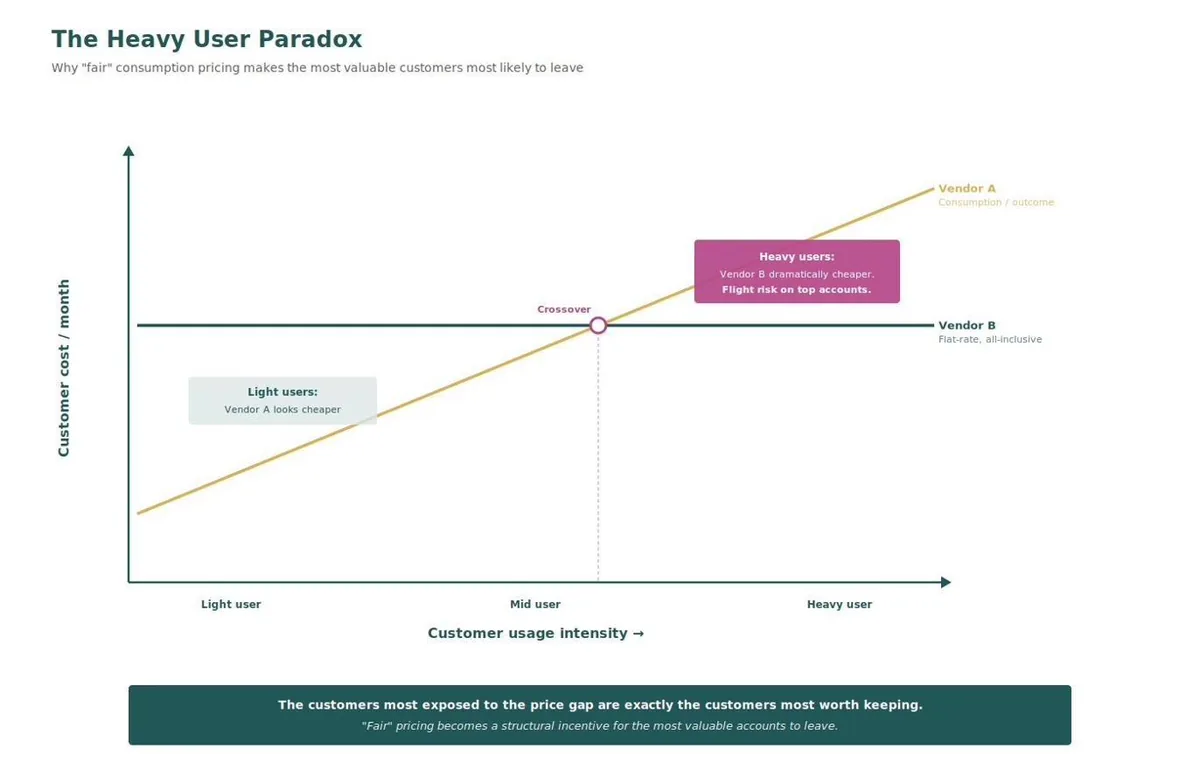
The „fair" model becomes a structural incentive for the most valuable accounts to leave. The same dynamic shaped mobile data, electricity and cloud infrastructure pricing, where value-based logic lost more battles than the textbooks suggest.
Three structural conditions that hold the model up
Product superiority. The product is materially better than flat-rate alternatives. Heavy users absorb the premium because they are buying capability, not price. Real product superiority is rare and decays over time.
High switching costs. The cost of leaving, data migration, retraining, integration rework, regulatory revalidation, exceeds the price savings from switching.
Absence of relevant competition. No credible flat-rate alternative exists in the vertical. The most fragile of the three, because the absence of competition is rarely permanent.
Where none of the three conditions holds, the dangerous middle, with a product at parity, switching costs eroded by AI dynamics and an open competitive landscape, sophisticated pricing becomes a slow-motion exit from the best accounts. The right answer is not to design defenses around a vulnerable model. The right answer is to choose a different one. Mixed Models are often that different one: the subscription foundation creates a switching-cost layer that pure consumption does not have, and a flat-rate competitor would have to displace the entire stack rather than just undercut the consumption part.
The bottom line
The transformation is not about adding AI features to existing software. It is a fundamental shift in what creates value, from process execution to intelligence, from closed systems to open ecosystems, from tools to platforms. Recognizing the shift is the easy part.
Choosing the right pathway, and committing to its execution, is the central strategic question for vertical software leadership over the next 24 to 36 months. And sophisticated pricing is not automatically better. It is better only when the conditions to sustain it are present. In their absence, the smart move is the one that doesn't look smart in the deck, but holds up in the market.

One of Europe's leading experts on the monetization of software products, with more than 150 pricing projects behind him.